


अद्वैतवेदान्तः in Practice : Understanding Meta-cognitive Mental Models by Transmuting Them into Control Systems

Updated: Mar 24
I resigned from my last job after a location change. The culture in the new office was significantly more emotional and less goal-oriented. Implementing simple closed feedback loops with accountability was perceived as a questioning of trust. My squad lead observed in a one-on-one that culture is hard to fix and that an open-loop approach of not providing any feedback at all would be more effective. "People may or may not take corrective feedback well, but they will always remember how you made them feel", he said. I grew up in a culture where feedback, even harsh feedback, was treated as an opportunity to learn, and learning was a privilege to be grateful for. Naturally, while this approach was robust and avoided noise, it felt like a regression, as it failed to recognize that trust and rationality can coexist. One does not imply a disrespect for the other. This regression would ultimately transform me from a self-correcting agent into a strictly feed-forward component—a funnel to extract value through, rather than a system that seeks to learn and grow.
A sense of meaninglessness set in.
To address this, I began reading A Full Spectrum Theory of Vertical Growth and Meaning Making (ref.) by Loevinger et al., at a friend's recommendation. As I walked through each of the levels proposed in the study, I realized that the journey of ascending them is synonymous with the concept of मोक्षः that I was taught growing up. The culture that a person grew up in strongly influences the level that forms the core of their initial comfort zone.
"People don't have ideas, ideas have people", Carl Jung famously quoted.
Ideas define how a person acts, perceives, and understands. These, in turn, may or may not motivate a person to act based on what they currently observe. These ideas are formed mostly by their interactions with the static and dynamic components around them.
Static components are easy to understand because they can always be trusted to behave a certain way when exposed to a large range of stimuli. A glass of water will always spill when you knock it over.
The dynamic components are often what form unique ideas and, consequently, people. A glass of water will always spill when you knock it over, but will Mom react to it the same way every time?
Other people form the dynamic components around us. It stands to reason that the influence these people have on us impacts the ideas we develop. From my experience in businesses (because most of my time these days is spent on work, fortunately or unfortunately) and reading (ref.), the influence of one individual on another at any given time seems to behave as such -
where,
i is influence,
tr is trust,
c is how well the influencer communicates to the influenced,
rp is reputation,
e is expertise, and
t is time.
Value addition to the position of the influenced also counts, but only if they have an idea of what value is to them then. This is rare, so I've not factored it into this description.
R.I.M Dunbar proposed Dunbar's number in his Coevolution of Neocortical Size, Group Size and Language in Humans (ref.), which has a strong relation to trust, volume of communication (and consequently communication itself), and reputation (as inner circle members know each other). Expertise is perceivable only when one can recognize it and feel its impact. Therefore, it is related to reputation, as those who can recognize and feel it begin to talk about it.
As such, we can use this model as a reasonable estimator for influence, even if not exact.
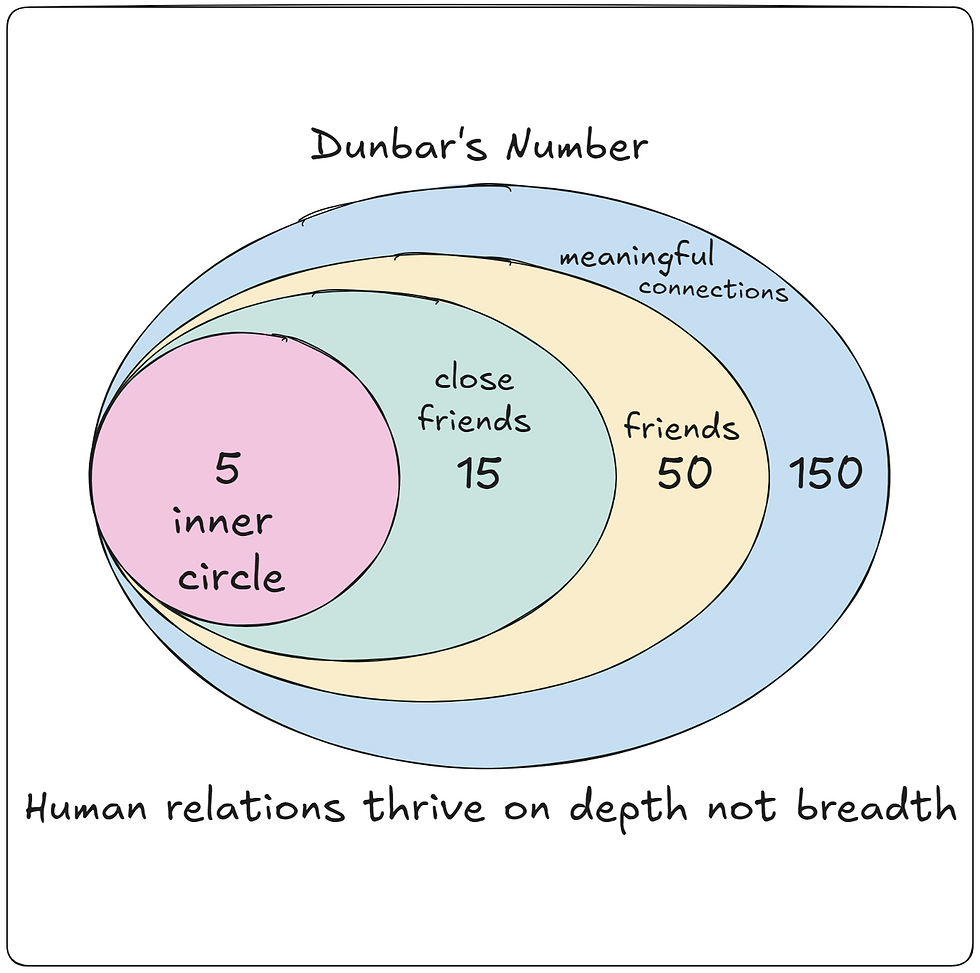
Influence is an indicator of the formation of ideas and, thereby, individuality.
It impacts the formation of ideas and, consequently, systems of dynamic interactions. Developing an understanding of the entirety of such systems requires continuous modelling and data collection via interaction with and from the world around us.
Rationality is key to the realization of such systems, to creating value with them and to scaling them, as you can never really claim to understand something unless you can explain it (even if only to yourself), and as an extension of that explanation, reproduce it.
Understanding creates certainty. Certainty creates comfort. Comfort with everything in your domain of awareness creates bliss. When you can observe and understand all there is, that's bliss everywhere you go. The purest form of freedom is where you create your own, and it's not at the mercy of any other factor outside of your control.
Convince yourself that there is no route to bliss for you, and you'll wind up killing yourself.
Convince yourself that you are a trustworthy provider of your own bliss, and you'll never be fazed by anything.
Convince another person that there is no route to bliss for them, and you can drive them to suicide.
Convince them that you are a trustworthy and reliable source of it, and they will be in your complete control.
Everyone has a compass that guides them to this sense of bliss, although it may present itself in different forms. The route to it can be found through understanding.
The problem of understanding was addressed in the last article (ref.). After further reading, this solution turned out to be an intersection of अद्वैतवेदान्तः philosophy.
It is to address the gaps in this solution and scale it that this article discusses a theory of the iterative transmutation of meta-cognitive mental models into control systems, as a means to understand the nature of everything in a rational manner.
What's the point?
मोक्षः, being the realization of आत्मा, is the result of a journey to understand the true and unchanging nature of the self, soul and ultimate reality, confirmable through eternal freedom from attachment, ego, and suffering. जीवनमुक्तिः, being the final attainable state of मोक्षः while being alive, is what we can actionably define as the end goal of our lives and what we will assume to be मोक्षः for the remainder of the article.

The accounts of आदि शङ्कराचार्यः recorded in निर्वाणषट्कम् (ref.) act as both primary sources for and confirmation criteria for the attainment of जीवनमुक्तिः -
मनोबुद्ध्यहङ्कार चित्तानि नाहं
न च श्रोत्रजिह्वे न च घ्राणनेत्रे ।
न च व्योम भूमिर्न तेजो न वायुः
चिदानन्दरूपः शिवोऽहम् शिवोऽहम् ॥१॥
न च प्राणसंज्ञो न वै पञ्चवायुः
न वा सप्तधातुः न वा पञ्चकोशः ।
न वाक्पाणिपादं न चोपस्थपायु
चिदानन्दरूपः शिवोऽहम् शिवोऽहम् ॥२॥
न मे द्वेषरागौ न मे लोभमोहौ
मदो नैव मे नैव मात्सर्यभावः ।
न धर्मो न चार्थो न कामो न मोक्षः
चिदानन्दरूपः शिवोऽहम् शिवोऽहम् ॥३॥
न पुण्यं न पापं न सौख्यं न दुःखं
न मन्त्रो न तीर्थं न वेदा न यज्ञाः ।
अहं भोजनं नैव भोज्यं न भोक्ता
चिदानन्दरूपः शिवोऽहम् शिवोऽहम् ॥४॥
न मृत्युर्न शङ्का न मे जातिभेदः
पिता नैव मे नैव माता न जन्मः ।
न बन्धुर्न मित्रं गुरुर्नैव शिष्यं
चिदानन्दरूपः शिवोऽहम् शिवोऽहम् ॥५॥
अहं निर्विकल्पो निराकाररूपो
विभुत्वाच्च सर्वत्र सर्वेन्द्रियाणाम् ।
न चासङ्गतं नैव मुक्तिर्न मेयः
चिदानन्दरूपः शिवोऽहम् शिवोऽहम् ॥६॥
This provides us with a definition of the end goal mentioned earlier, and it makes sense - eternal bliss is objectively better than any other state of mind that could exist.
Some can visualize and understand this goal at an earlier stage in their life, whereas some require a stronger footing in other areas before doing so. The nature of people and their decision-making systems is random, so it's hard to tell what each individual's conditions are to be able to see this at any given point in time, unless you have large amounts of experience with and data on them.
So how do I get there while also doing what I need to do?
As such, to look at this problem from an outside-in perspective, we have the पुरुषार्थः proposed by श्रीकृष्णः. Their reasoning in महाभारतम् can be considered a result of extensive red-teaming of the same against real-world data.
It finds its श्रुतिप्रमाणम् in गणपति अथर्वशीर्ष उपनिषद् -
सायमधीयानो दिवसकृतं पापं नाशयति ।
प्रातरधीयानो रात्रिकृतं पापं नाशयति ।
सायं प्रातः प्रयुञ्जानो पापोऽपापो भवति ।
सर्वत्राधीयानोऽपविघ्नो भवति ।
धर्मार्थकाममोक्षं च विन्दति ॥१३॥
This defines the wholeness of the self, soul, and absolute reality that constitutes life.
This encompasses the goal of मोक्षः, supported by the pillars of अर्थः and कामः, built on the foundation of धर्मः. An understanding of them all for individuation requires the rational, critical, and systematic inquiry into fundamental questions regarding existence, knowledge, ethics, reason, and reality. Or in other words, a philosophy.

Deriving a philosophy requires a large quantity of empirical perception and a corpus of reasoned investigative results. Luckily for us, the same आदि शङ्कराचार्यः from before also spent his life developing and cross-verifying the philosophy of अद्वैतवेदान्तः, so he'll be the giant on whose shoulders we'll stand today. It's considered the most thorough consolidation of सनातनधर्मः in Hindu history and gains its authority from exceptionally consistent victories in debates throughout the 8th century, and laid the foundation of the भक्तिः movement that propagated its conclusions throughout the Indian subcontinent.
अद्वैतवेदान्तः proposes ज्ञानयोगः as the direct method to achieve मोक्षः. It provides the following as श्रुतिप्रमाणम् - स यो ह वै तत् परमं ब्रह्म वेद ब्रह्मैव भवति नास्याब्रह्मवित्कुले भवति ।
तरति शोकं तरति पाप्मानं गुहाग्रन्थिभ्यो विमुक्तोऽमृतो भवति ॥
"He who knows Brahman becomes Brahman." This 9th verse of मुण्डकोपनिषद् equates the act of knowing directly with the state of being liberated.
वेदाहमेतं पुरुषं महान्तमादित्यवर्णं तमसः परस्तात्।
तमेव विदित्वातिमृत्युमेति नान्यः पन्था विद्यतेऽयनाय॥
"Only by knowing Him does one pass over death; there is no other way to the goal." This 8th verse of श्वेताश्वतरोपनिषद्
Additionally, भक्तिः योगः and राजयोगः can also be considered preparatory युजः to make oneself ready for the pursuit of ज्ञानयोगः. However, the purpose of this article is to define a method of gaining higher-order understanding through feedback loops, so I'll leave it to the reader's curiosity to learn more about that.
In the last article (ref.), we translated मेधः as wisdom and sacrifice simultaneously, which was interpreted for simplicity as reading and doing. However, this is not a consistent extension of the translation, especially in the context of ज्ञानयोगः. Work is presented as a means to produce something to observe (साक्षी भावः, a key inquiry method in ज्ञानयोगः). However, this taints the position of the योगी as being in the position of the doer rather than the uninvolved observer. This is the point where the method of learning proposed in the last article fails to scale.
If followed at scale, it puts the practitioner in a position where information happens from the frame of reference of an observer. Still, information egress happens in the frame of reference of the doer. In other words, wisdom is acquired with the context of an uninvolved party, but sacrifice is made in the context of an involved party.
Identifying as the doer creates hysteresis and bias. If the observer wants pure data, the doer keeps tainting that data with emotional noise from the previous action.
This doesn't make a difference when the subject being learned is rational, because static corrections can be made to the action to account for execution errors, since the context itself is rational. However, rational agents are only a subset of the observable universe.
Therefore, how can one understand the true and unchanging nature of the inner self if the objective against which it is resolved is itself not rationally predictable?
To account for these inconsistencies, अद्वैतवेदान्तः proposes a series of preconditions to qualify to practice ज्ञानयोगः. I won't get into this in depth in this article, but I will leave you with the information that अद्वैतवेदान्तः also considers the other three युजः proposed by श्रीकृष्णः as valid paths to attain these precinditions, but not मोक्षः itself.

Instead, I'll integrate it with our proposal to transmute meta-cognitive mental models into control systems with the following commentary by आदि शङ्कराचार्यः on श्रीमद् भगवद्गीता ।।३.३।।
लोके अस्मिन् द्विविधा द्विप्रकारा निष्ठा स्थितिः पुरा सर्गादौ प्रजाः सृष्ट्वा तासामभ्युदयनिःश्रेयससाधनत्वेन प्रोक्ता मया सर्वज्ञेन ईश्वरेण अनघ व्यसनवर्जित।
"The path of knowledge of the Sankhyas (Jnana Yoga) was described by Lord Krishna in chapter II, verses 11 to 38, the path of action (Karma Yoga) from 40 to 53. Pura Prokta may also mean In the beginning of creation, the twofold path was given by Me to this world. Those who are endowed with the four means and who have a sharp, subtle intellect and bold understanding are fit for Jnana Yoga. Those who have an inclination for work are fit for Karma Yoga. (The four means are discrimination, dispassion, sixfold virtues, and longing for liberation. The sixfold virtues are control of the mind, control of the senses, fortitude (endurance), turning away from the objects of the world, faith, and tranquility. A man can't practise the two Yogas simultaneously. Karma Yoga is a means to an end. It purifies the heart and prepares the aspirant for the reception of knowledge. The Karma Yogi should take up Jnana Yoga as soon as his heart is purified. Jnana Yoga takes the aspirant directly to the goal without any extraneous help."
Essentially, कर्मयोगः can be considered a means to achieve the preconditions to ज्ञानयोगः and only a means to achieve मोक्षः indirectly. At this point, a reasonable question that arises is - "Why invest in कर्मयोगः as a means to satisfy the preconditions of ज्ञानयोगः when the end goal of both is the same?"
This is because अद्वैतवेदान्तः interprets the primary accounts of मोक्षः as a result of the lack of distinction between the self, the soul, and the absolute reality. One cannot understand absolute reality by relying on action as the method of choice.
अयम् आत्मा ब्रह्म ॥ मांडूक्य उपनिषद १.२ ॥
ⓘ  A Tangential Point

Renunciative schools of thought that adopt ज्ञानयोगः as a direct path to मोक्श in Vedic Hinduism tend to be Shaivite due to his identity as a योगी, whereas retentive schools of thought that adopt कर्मयोगः as the direct path to मोक्श tend to be Vaishnavite due to his active involvement in भूलोक through action. The path that resonates with the individual can be considered an indicator of the self-soul-ultimate reality relationship that would be most suited to their belief.
Now that we have an intuition of
मोक्षः as the goal,
पुरुषार्थः being the requirement definition,
अद्वैतवेदान्तः as the philosophy,
कर्मयोगः in preparation for ज्ञानयोगः as the means, with
The definition of a method of reaching higher-order levels of awareness through feedback loops as the reason,
we can proceed to understand each of the aforementioned levels, perceive their signals, and scale them.
How do I understand the nature of each level with control systems?
Physics is the study of matter, energy, space, and their interactions over time. It's an easy system to understand because it's verifiable through inquisitive cycles of theoretical proposition, experimentation, and verification. Atomicity can be achieved by breaking down complex structures into substructures whose effects can be defined within a boundary via the same process.
One can establish atomicity and gain an intuition of how a certain thing will behave when you poke it in a certain way by observing and experimenting. The ability to observe the full sample space of all entities and forces that can influence or be influenced by a thing across time makes that thing ready for study and understanding. If one cannot observe, one cannot understand.
ⓘ  An Orthogonal Point

Understanding of a thing across time is built through observation of how that thing responds to different stimuli and issues stimuli of its own to affect surrounding things.

In the control loop of observation → (cause to thing → effect to and by thing) → recording of the observation, one can just watch a thing exist for a realy long time and understand it. This is the bare minimum case and the reason why अद्वैतवेदान्तः asserts that it is possible to attain मोक्षः purely through a lifelong commitment to ज्ञानयोगः.
To establish the aforementioned atomicity of understanding, we need to build a unit of the very process of understanding itself. Without the ability to understand, there is no point in observation and vice versa.
Let's start with the control loop. We'll define it as a closed loop, as a closed loop can be fully explained and understood, with the ability to self-accelerate and scale in terms of the quantity of data processed per cycle, which is aligned with our goal here.

To understand something, we need to build a system containing the mind (where the understanding takes place and ideas are generated), a means to manipulate, a means to perceive, and the object requiring understanding itself. The ability to manipulate is necessary here, as it allows us to produce more samples of data from the object to be understood within a slice of time. This is useful when the objects themselves are slow-changing, as systems tend to be as you move up the ladder in terms of levels of awareness, interaction, and thinking.
First, an initial observation of the current state of mind is necessary to understand both the self and the natural tools it provides at your disposal - the ability to observe, the ability to understand, and the ability to produce ideas. It's easier to notice these when the mind is at peace and kept away from chaotic forces like emotion.
After obtaining an initial understanding, the mind produces an idea. This could be either a concept or a function.
A conceptual idea that is built on reasoned inference or comparison with what is known helps gain more understanding from the same observed sample. This is processed wholly within the mind.
A functional idea seeks to interact with the world and gather the effects as data. It is expressed outwardly as an instruction.
The first component of intelligence is the rate of production of ideas. The ratio of functional ideas and conceptual ideas needs to be chosen based on the degree of complexity of the conversation being had or the degree of impact of the problem being solved. This is the proper way to channel that intelligence into understanding and creating value at each level.
Our control loop is one that inherently interacts with the world around us. Therefore, we will seek to operate only on functional ideas. However, the aforementioned balance is important to keep in mind. Complex problems require more cycles to be dedicated to conceptual idea production to construct a better mental reasoning of the system. If more functional ideas were produced here than conceptual ones, it would be destructive to the system, as you're essentially acting without understanding, like a baby knocking over glasses without cognizance of the fact that it might break or inconvenience mom.
The manipulator is an entity (either a part of the self or a separate person or machine) that takes an instruction and produces an action and/or a disturbance targeted at the object of study. This is to trigger state changes in it and also understand how disturbances to expected state changes resulting from actions impact the object. To execute more complex functional instructions, you may need more than one manipulator to act on different parts of the same object of study. This could be another person whom you trust to carry out your instructions exactly the way you communicate them.
A good quality manipulator (be it within or without the self) -
Executes instructions.
Requests clarification in case of ambiguity in the instruction.
Points out when the instruction will not produce the expected outcome or will cause problems.
Does not refuse instructions.
If the manipulator is external to yourself, requiring too many loops of clarification has the same effect as refusal and is generally an indicator of too many levels of difference between the instructor and the manipulator.
Once the object of study changes state due to a stimulus from the ambient environment or as a result of action/disturbance from the manipulator, it is ready to be observed.
प्रत्यक्षानुमानोपमानशब्दाः प्रमाणानि ॥ न्यायसूत्रम् १.१.३॥
The second component of intelligence is the rate of collection and retention of observations. An observation that provides signal rather than noise and an objective view of the truth in that frame of reference is generally one of
प्रत्यक्षम्, perception - a first-order observation that is directly made through sight, sound, touch, smell, and taste.
अनुमानम्, inference - a second-order or derivative observation that is derived by
Proposing a theory.
Backing it up by reasoning logically from a perception.
Backing it up again with a known observation (could be any of the four types).
Backing it up again with an example (if one doesn't exist, then demonstrate by creating an observation by proof of concept).
Conclusion justifying that the originally proposed theory is a new and original observation.
उपमानम्, comparison - a second-order observation, derived after a perception of similarity is established with a first-order observation.
शब्दः, trusted testimony - a second-order observation made from the testimony of a trusted perceptor.
First-order observations when the manipulator is part of the space of total control (or the self) are the most trustworthy, as the loop has fewer potential failure points that cannot be controlled.
Inference is the most sound of the second-order observations if it doesn't rely on a second-order observation for backing.
When multiple manipulators need to be instantiated to take action on the object, and multiple perceptors are required to observe the effects, then they are only within the space of total control if they are tools. If they are people, then they are reliable only if they have established trust.
When one needs to perceive and manipulate systems with multiple degrees of complexity, this control loop will need to scale to capture that data through the instantiation of more perceptors and manipulators or increasing the quality of one's own ability to perceive and their ability to manipulate (power and influence). Manipulation without completing the loop through perception and understanding becomes indistinguishable from tyranny as it inevitably accumulates drift errors and deviates from reality.
The third component of intelligence is the speed of obtaining an understanding. Once observations are obtained from all impacted areas, they have to be consolidated and converted into an understanding.
आत्मा वा अरे द्रष्टव्यः श्रोतव्यो मन्तव्यो निदिध्यासितव्यो मैत्रेयि ॥ बृहदारण्यकोपनिषत् २.४.५॥

बृहदारण्यकोपनिषत् २.४.५ outlines this process as three successive steps
श्रवणम्, listening - gather all the observations.
मननम्, reflection - question and reason them against each other to eliminate logical inconsistencies.
निदिध्यासनम्, meditative contemplation - verification against known truths from memory or teachings.
The speed of this process can be improved with sample efficiency (better retention of past understandings so that contemplation can happen faster) or with more cycles per unit time.
It's only after this process that we become ready to apply our creativity to issue new instructions to understand impacts that were not producible in the last instruction cycle.
Problem-solving is when we create instructions to align the behavior of the object with an expectation, based on our current understanding. The solution becomes more potent the more understanding already present. While this may not reveal something new, it strengthens understanding through external validation and commitment to memory.
An instruction in this frame and a decision in the real-world frame are synonymous. After observing the necessary processes of understanding, we can verify the practicality of our instruction if it has the following properties (ref.)
A clear decision frame - scope of impact the instruction will have. This should be limited and have clear boundaries. It should not be infinite.
Clear values to adhere to and objectives you are trying to accomplish - a clear definition of the objective of the instruction and alignment of the instructions with predefined values.
Creative alternatives to choose from - there should be alternatives that can be taken to achieve the above.
Good information - information collected to make this decision/issue this instruction should be focused on the objective only.
Clear tradeoffs and sound reasoning - if the decision conflicts with another objective, the tradeoffs should be known.
An observability network is necessary to monitor the execution of a decision and check if it has resulted in the expected outcome. In the case of problem-solving, it needs to be checked if the defined problem has been solved and the objective met.
An observability network is a graph of perceptors that observe all impact areas of a solution using first-order or second-order observations, verifiable against first-order observations. Each node in the graph should be able to provide observations on the problem periodically, with the period determined by the quantum of work to be done.
In the real world, this could be anything from metrics, logs, and traces within a software system to splitting a problem and delegating it amongst your reportees and obtaining observations on the task execution through meetings.
The problem of understanding people is the same as understanding their ideas. People are ideas after all. Observing their actions to build an understanding is sufficient, as actions never lie and produce first-order observations. However, when you do it by connecting with them and making them feel seen, you can build both an understanding and a relationship.
ⓘ  Another Orthogonal Point

If you're able to observe more cause/effect pairs per unit time for a thing, you can understand the nature of that thing faster simply due to the volume of data collected. The easiest way to do this is to poke that thing with an action and watch it and its area of effect till it stabilizes at a certain state.

When you poke something that is above your current level of observation to understand it, e.g.; run a line of code that you've never seen before and understand its limits and edge cases - that's कर्मयोगः.

When you poke or watch something that is equal to or below your current level of observation to understand it and through it, something greater, out of passion or curiosity, e.g.; by caring for a being, watching out for what makes them happy, understanding and reproducing it - that's भक्तिः योगः.

When you poke yourself, e.g.; by meditating to calm yourself or observing ethics to see what about you gels with people and what doesn't and understand all parts of yourself - that's राजयोगः.

Ultimately, understanding itself precedes realization, which is a state of ज्ञानयोगः and the reason why अद्वैतवेदान्तः treats it as a terminal state preceding मोक्षः.
What are the levels at which these control systems can be established?
Levels, the inspiration for this article, refers to the developmental levels of the human ego, proposed by the same Loevinger who was mentioned in the introduction. The concept itself has been summarized really well in this video by the YouTuber, hoe_math.
It summarizes the model of human consciousness based on the work of multiple researchers and the route of one's ascent through it in the pursuit of self-realization.
I found this inspiring because while I had read about these concepts in theory as part of a learning interest in Hindu scriptures and अद्वैतवेदान्तः in general, I felt like I was being shown how to move individual pieces on a board by understanding the universal law of how everything behaves, but I was never able to visualize the board itself. I had an intuition of how these concepts worked because I'm a systems architect by profession, but I felt uncomfortable with my inability to explain them. A huge component of trust in anyone is whether or not they understand what needs to be done, and I felt like I didn't have that with myself.
However, it's important to be conscious of the fact that this is a construct. These levels are a perception of the route to self-realization by someone whose ideas are the product of another culture and have their own unique viewpoints. In Hindu culture, there isn't much explicit talk of these many levels. For example, अद्वैतवेदान्तः more or less paints the picture of a diad. It lays out the explicit conditions in the form of साधनचतुष्टयम् to be ready for the path of ज्ञानयोगः. This seems to represent the conditions to transition from first and second-tier consciousness to third-tier consciousness and exercise it. Although the concept of tiers of consciousness themselves are not constructs that this manner of perception recognizes.
Levels are just easier to explain in an understandable manner because it's broken down a complex journey into many more sub-steps than other approaches, like साधनचतुष्टयम् from अद्वैतवेदान्तः or Carl Jung's theory of individuation. They all paint pictures of the same mountain, although अद्वैतवेदान्तः seemingly paints the biggest picture of them all to the point where the details may get difficult to perceive. Additionally, they also provide some useful mental models to act as caches for quick and rough judgments to perceive situations faster.
I personally found that walking through these levels as a mental exercise and challenging myself to find examples of real-life problems that could only be seen with each level of awareness was an effective exercise to get an intuition of how to perceive and visualize data in higher dimensions, and understand it. Coming up with creative solutions after that completes the loop of learning. That's why the explanation of each level increases in size with more diverse examples in the following section of the article. It's to help understand the concept from multiple perspectives.
Now that we've covered the concepts of control systems, understanding the nature of the game, and manipulating it with that, we can cover the levels of cognition that constitute the board itself, or in other words, meta-cognitive mental models.
Level 1
Priority: Protecting the self.
Primary drive: To survive
What do I need and how do I get it? Nothing else concerns me.

Level 2
Priority: Protecting the self.
Primary drive: Connect with others
I can understand that someone other than me could need something.

Level 3
Priority: Protecting the self.
Primary drive: Control the situation
I can understand the relationship between people other than me, and want to impact it in a way that benefits me.

Level 4
Priority: Protecting the group.
Primary drive: To fit in
I can put myself in someone else's shoes and understand the situation from their perspective.
Due to this, I can't reasonably claim to be the most important person in the universe anymore.

Level 5
Priority: Protecting the group.
Primary drive: To achieve an objective view that stands true no matter which group it's put in.
I can see why some groups of people are different from other groups and make objective observations that stand true for all. I have no awareness of any other truth, and therefore mine is absolute.

Level 6
Priority: Protecting the group.
Primary drive: To understand what's going on
I can see that the direction that I'm looking will impact what I perceive. The objective truths that I established earlier don't hold up universally because I built them by looking at my object of study from a particular direction. When I change my direction, I seem to be able to build a new set of objective truths that coexist with the previous set of objective truths that I found. Therefore, the coexistence of two truths is possible, and people can have multiple non-conflicting perspectives on things.

ⓘ  A Transitionary Note with Opinions for Relatability

This is the boundary between level 6 and level 7. It separates those whose primal motivation behind their priority is fear (first tier consciousness), and those whose primal motivation behind their priority is existence (second tier consciousness).

Observations of this diad can be found in many different paradigms in nature and society observed by others.
Hunters and the hunted, predators and prey, officers and soldiers, owners and workers, bourgeoisie and proletariat etc. Proposers of those terms generally believe them to be absolute categories that may not be able to coexist, but they actually can.

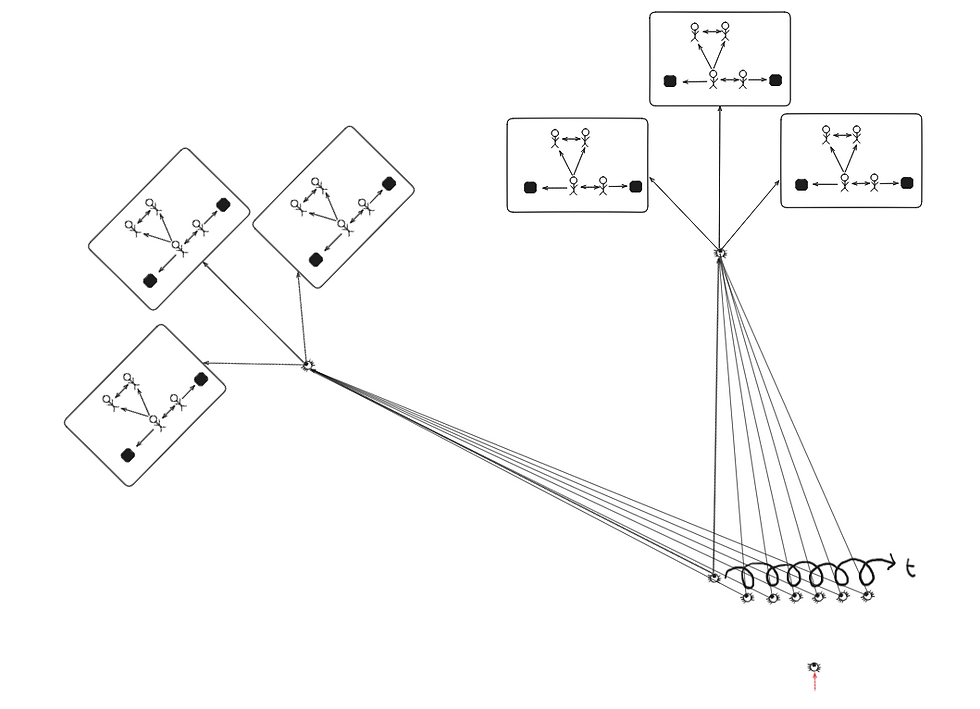
Whether or not they may be conscious of it, one can choose to embody perspectives at different levels. How much time one spends at each level can be gauged by the frequency of expressions of their thoughts and the alignment of those thoughts with how a being at each level perceives their environment.

The longer a person maintains such a view, the easier they can stabilize at a level. Once you are able to have stable access to level 7 any time you want, you gain the skill to place yourself at any level you please, if not the awareness. Your bottleneck to acheiving your goals move from the ability to do, to the ability to know.

This is where you start trying to understand what the chessboard of existence looks like in its entirity. In this layer, you are no longer a piece on the board, but the player itself. You start to develop the ability to recognize other players, whether or not they are aware that they are players themselves.

Once you have more or less understood the board, you are now free to move the pieces as you see fit.
- Entities (living or non-living) become the pieces.
- The methods they employ to acheive their primary drive become their behaviour. These methods become tools for the player.
- Information becomes the chessboard. The chessboard also looks different with time, so one could call this a four dimensional construct.

This understanding comes naturally to those who have not felt fear of anything for a long time and thereby no longer see it as a motivating factor to anything at all.

Age is not a necessity though. There exist young adults and children that already do not seem to find peace when placed inside any kind of construct because they are either born with heightened awareness (children on the spectrum) or are forced into that state due to childhood experiences (usually traumatic experiences. they gain significant advantages at the cost of longer term harmony).

They are naturally construct aware, even if they are not able to spell it out or define it. They dislike the imposition of constructs onto them by others as they are able to recognize what imposition is because they are aware of what constructs are and their inherent unfairness, and naturally self-organize into social webs. Don Beck reasons these phenomena in his works on Spiral Dynamics.

With time, these people turn out to be the most successful in any society because their natural talent backed by experience will always beat out those that have onlly one of the two. They are able to maintain that position of success no matter how society transforms because they recognize that society itself is a construct, quickly identify the paradigms for success in it and turn it into systems and procedures that they can spam to acheive what the first tier conscious masses perceive as the absolute nature of success. They also can decide whether or not they die happy and realized individuals.

They are the apex predators of society who can define themselves and act accordingly. Therefore, their priority becomes the realization of self.
Level 7
Priority: The realization of self.
Primary drive: Identify what people want, where things belong, and satisfy everyone's unique needs so that everyone can chill.
I understand that individuals with different capabilities have different perspectives that are non-conflicting due to the validity of their origin, and these perspectives can change over time. For example -
Someone whose priority is their own needs, who is starving, will look for food. Once they eat the food, their need might change to something else.
Someone who sees someone else needing something might provide it to them. Now that person will see that the other person's need has changed and do something about that.
Someone might convince two other people to stop talking loudly so that they can sleep. Once they have woken up, those other two people are hungry and bothering this person for food. Now he/she might either feed them to be at peace or drive them away to save money. Either way, the only priority is to meet their own changing needs over time.
Someone might look at a normal ongoing discussion between two others, observe the fact that one said something in a tone that would be considered rude, and watch the conversation turn sour, receive a response that would be considered rude to the first, and either escalate or de-escalate with time.
Someone might look at a normal ongoing discussion between two others, observe the fact that one said something in a tone that would be considered rude in the other's culture, and watch the conversation turn sour, receive a response that would be considered rude in the first, and change their perspective on what rudeness might mean with time.
Someone might draw multiple co-existing objective truths as conclusions from changing the way they look at the same heated discussion by two people from different cultures, by noticing all the various ways offense could have been taken through different interpretations of the same situation. If we slice the same situation by time, the sets of co-existing truths that can be drawn by taking different viewpoints on the situation at a particular time change.
My own interpretation of the last six examples may change with time, with phenomena like the evolution of cultures themselves, the evolution of individuals and their persona, and the evolution of ease of access to material and immaterial needs to society at large.
Therefore, drawing from the principles of chaos theory (ref.), the entire system has:
No linearity - it's possible that small changes might produce very large consequences in a manner where the small change that sparks a larger cascade cannot be identified.
Topological mixing - any given section of the system can evolve into something larger and more complex than itself over time.
Computability - at such scales, it becomes hard to measure an initial state, as the system itself has changed in the time it takes to get a measurement. That increases the computational overhead to predict the nature of the system in a future slice of time, over and above the case where a perfect snapshot can be synchronized and captured.
Entropy - assuming that such a perfect snapshot can be captured, the same snapshot of two initial states does not guarantee the nature of the final state. It's not a functional relationship.
For all intents and purposes, the system has become random. We can only try to conclude final states based on observed patterns in perfectly captured, time-series snapshots of the system at best. Although the direction established by these patterns remains clear.

ⓘ  Opinions on a Paralellism for Relatability

Anyone who has not practiced this stable access to second tier consciousness through reasoning or lacks मुमुक्षुत्वम्, a burning desire to liberate themselves, will probably just dismiss it and choose the path of experience rather than knowledge.

It's not their fault. They are just not accessing the higher dimensions of thought that their minds enables them to.

If you were a sentient square in a two dimensional world, a cube entering your plane of existence could present itself as a point, line segment, triangle, square, rectangle, trapezoid, pentagon or hexagon in your frame of reality, as those are its 2D cross sections. Without reasoning, perceiving its cubical nature is impossible, but the cube can fully perceive your nature as a square. The advantage is unidirectional at first but can be closed with questioning. Questioning allows you, the sentient square to perceive the true forms of anything. Stable access to a higher tier of consciousness means to be comfortable with uncertainities and resolve them with questioning in order to see their true form.

I believe we are all cubes. We just need to look at the other squares from more points of view till we perceive them to be what they actually are - cubes. Otherwise we're limiting ourselves to a lower plane of understanding with no real advantages. If we don't use our minds to their fullest capacities by proper perception through the प्रमाणानि and श्रवणम्, मननम् and निदिध्यासनम्, they will scramble themselves with inherent agents of chaos like desire, attachment and emotion. There are some theories that this is a manifestestion of शक्तिः that has been awakened in a person. It's nature being pure chaos itself, requires channelling through processes like observation through प्रमाणानि, श्रवणम्, मननम् and निदिध्यासनम् to turn creative.

Every entity across the board finds peace faster when they practice this enough that they can perceive at higher dimensions (becoming ready by developing साधनचतुष्टय:).

The bottom line is that they must be able to trust that those with higher tiers of consciousness follow a common law (धर्मः). This trust cannot always be perceived but it can be felt. If it is not felt, the system self destructs.

For example, economic inequality is a historically strong indicator of societal collapse when money as a construct has a strong say in whether or not you feel fear on a day-to-day basis. When the volume of fear felt accumulates in the masses while they simultaneously observe lavish expenditures by others, they begin to build an intuition that the system is against their mental wellbeing.

Another example that is a superset of above example is material resource depletion itself. When nobody has reliable access to oil, they will start attacking the systems as reasons for why they don't possess it and suddenly, the acquisition of oil becomes something of such overriding priority in the collective consciousness that the idea of war being a practical tool to secure it becomes palpable. If they are smart, they will prevent this by migrating to a non-oil based infrastructure, but such executions are slave to time itself, so war is still on the table as a last resort option.

This is a higher level system than one where the concept of money makes sense. Instead, here people perceive value directly rather than wrapping the concept with the construct of money.

From this, we can infer that system where an entity cannot obtain money, or at a higher dimension, create or access what it sees as value, self destructs. In turn, we can reason that not allowing the access of value to an entity in a system can cause self-destruction of the system. Verification against historical events reveals this to have merit. Therefore, we have discovered a law of the system.

धर्मः is the law that the universe and thereby, the self (being the same as the universe per अद्वैतवेदान्तः), follows. We discover pieces of this law in through reasoning in the same way one cube can perceive another cube from different perspecives and reason that it consists of 6 sides with right angles, even though it can't see all of it in one glance.

For this reason, stories are probably a better means of explanation of धर्मः than an explicit codification of the laws. Records of observations of a cube can be contemplated on to discover the nature of the cube, but explicitly ruling that the cube is a line and should behave like one would not give the cube the true freedom to express itself in a manner that acheives it's current goal. The line is a construct that will only serve the cube so long as its goals are acheived and don't evolve to pursue higher dimensional goals and thereby require higher dimensional constructs. A great story shows the raw observations and allows the reader to construct their perception of reality with it. Stories with absolutes are boring to those who are aware of constructs, and destructive to unaware individuals those that take them seriously and attempt their enforcement.

People at all levels can perceive that रावणः was both bad for coveting सीता (the reasons themselves being wrong on so many levels), but also good for desiring her consent. Additionally, he was also not necessarily good for that last bit because one could argue that he was forced into developing one good quality because he was arrested by the curse of नलकूबरः. Ravana can't be boxed into a bucket of good or bad for all eternity, but despite all this, we could probably agree on certain truths that नलकूबरः cursing रावणः was an objective good and in line with धर्मः.
Level 8
Priority: The realization of self.
Primary drive: Identify what kind of person I want to be and exercise my will as a derivative of that to further my understanding and discover and maintain universal laws, the way I understand them.
I have understood and committed to memory the reasoned patterns and time-series observations made of my own evolving observation. Due to this, I can understand how my ideas themselves are constructed from my observations, and therefore, am free to act in a way that expresses what I truly want to do and choose what kind of person I want to be with a great level of control, as I can choose how I want to construct my perception of reality based on my intent. I am free to define what I am, and that will govern my actions. My actions are now subservient to my idea of self.
ⓘ  Another Transitionary Note with Opinions for Relatability

This is the boundary between level 8 and 9. It represents an evolution into 3rd tier consciousness.

By this point, you have developed such an acute understanding of the game itself that you instantly know where to look to observe something you want to learn. The only objective to learning is realization. If it's not, then you are sacrificing a shot at eternal bliss for a less valuable goal.

There is objectively no goal superior to the realization of self. You have not done sufficient inquiry into the reason for why the game existed in the first place if you do not believe this at this stage.
Level 9
Priority: The realization of the nature of self.
Primary drive: Identify the nature of self.
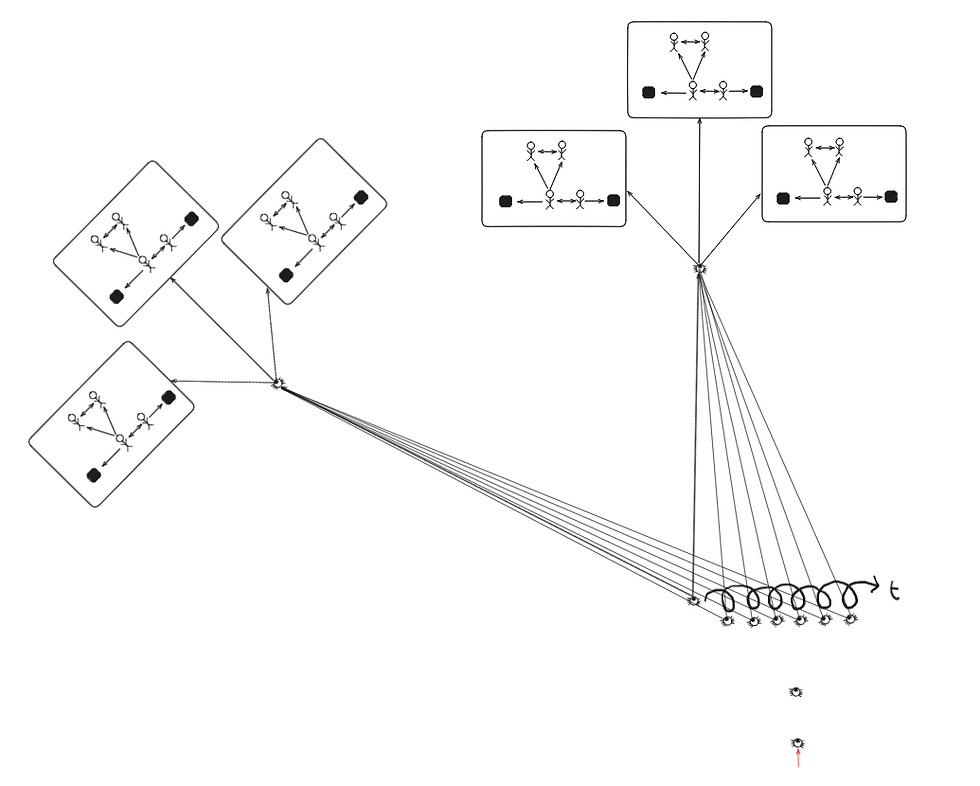
I have learnt how to understand myself. I have developed such a deep familiarity with the game and its multidimensional data structures that I no longer need to predict outcomes of patterns and self-correct my understanding. I know where to watch the system from and embody the self of a watcher at that level.
I have realized that there is no point in acting on the system anymore. It will not make a difference to my goal of identifying the nature of the self. In fact, the very act of acting reinforces the intuition of acting in my mind and requires energy, which is bandwidth that I can free up and allocate to my actual goal. I seek to free myself of action itself by any means necessary and evolve from a player in the system to a seeker of the truth of the nature of self.
ⓘ  A Parallel Point

The Hindu body of knowledge is bifurcated into शास्त्र & तंत्र in terms of their position on the understanding → action loop and into श्रुति & स्मृति in terms of authority.

शास्त्र is that which is recorded.
तंत्र is that which is instructed, e.g.; body postures and rituals.
श्रुति is that which is heard (by divine revelation).
स्मृति is that which is authored and remembered (by humans).

Every single scripture in this body of knowledge is up for debate. The reason श्रुति remain authoritative and immutable even so is because they can be interpreted differently based on context. This is how स्मृति can spawn from them, be cross-examined against them and expand into a limitless number of संप्रदाय.

Some शास्त्र are considered श्रुति, like वेद and उपनिषद्.
Some शास्त्र are considered स्मृति, like भागवतपुराण and महाभारतम्.

तंत्र are entirely considered श्रुति by Shaiva and Vaishnava sects, because they are believed to be divine revelation and immutable.

However, in the broader classification, they are considered स्मृति as they are authored, even if by a diety (ref.).
When executing anything in a level 9 mindset, it is important to block out inputs from all levels above the level of the problem you are solving, lest you get paralyzed by the noise.
Conclusions
That concludes the entire map of levels of thinking that would be required for perceiving and understanding the system of reality. It reveals what the relevant questions are to ask to obtain all possible perspectives on a problem once you localize at what level the problem lies.
The quadrants in the chart below provide a quick verification system to see if the questions you have asked have given you a full understanding of a problem or unknown that you are trying to perceive.
It also provides some useful observations on how to estimate an individual's ability to assess complexity based on the culture they come from and their history.

With that, I conclude this proposal for understanding the levels of depth of reality with control systems to understand their true nature.
In other words, understanding meta-cognitive mental models using control systems inspired by the principles of अद्वैतवेदान्तः.
Some material that may not have made it into this article, but was interesting nevertheless
https://excalidraw.com/#json=B-YNLvv0aHSQvjTK1h2aN,GwRywydB65g-G2dE9f835g | Excalidraw Whiteboard
https://rjwave.org/ijedr/papers/IJEDR2504599.pdf | IJEDR2504599.pdf
https://sebokwiki.org/wiki/Foundations_of_Systems_Engineering | Foundations of Systems Engineering - SEBoK
https://en.wikipedia.org/wiki/Shakti | Shakti - Wikipedia

Question: Advaita vedanta considers Arthapatti and Anupalabdhi as valid sources of knowledge. Can it really be practised without them, using Nyayasutra reasoning that both can be considered as derivatives of Anumana and Pratyaksha?